

Overview
Status
Completion Date
Themes and priorities
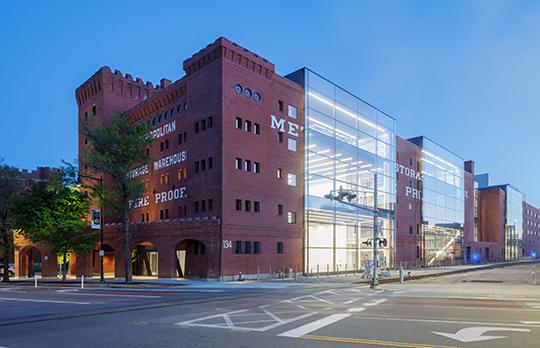
The adaptation and renovation of the landmark Metropolitan Storage Warehouse transforms the massive structure into a vibrant center of architecture, design, and planning, providing a new home for the School of Architecture and Planning (SA+P) and its MIT Morningside Academy for Design (MIT MAD).
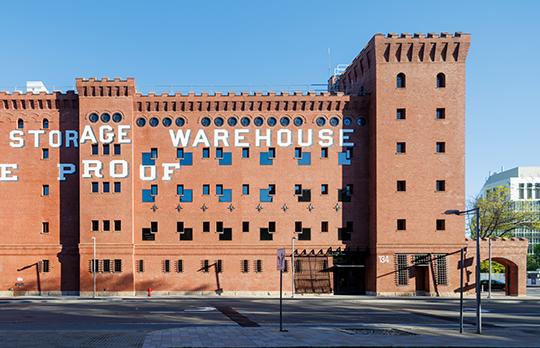
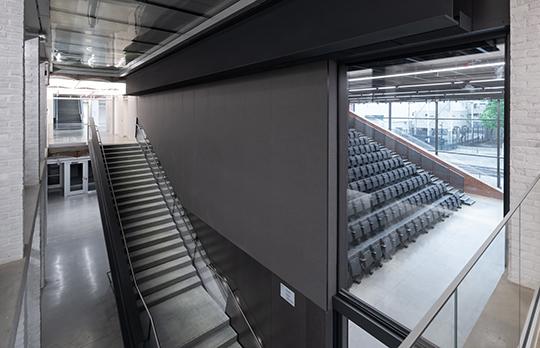
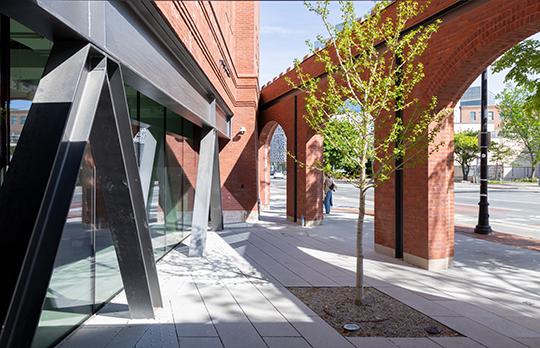
The MET’s five brick sections were originally designed by Frederic Pope (first section only) and Peabody & Stearns and were constructed in phases between 1894 and 1923; as one of the oldest and most recognizable buildings in the neighborhood, the MET is historically significant. To adapt the dense, dark storage building, the project team inserted four multistory glass-walled segments, creating open interior spaces and allowing for double-height studios. The design includes a new array of larger square window openings transposed over the grid of existing narrow windows, creating an exterior pattern of periodic intersection. Inside, the impact of this change is light-filled offices and meeting rooms.
Through a careful melding of original architecture and new design, the project team created new design studios, fabrication shops, research labs, classrooms, offices, an auditorium, public exhibition galleries, and a multitude of common areas for collaboration. The team worked in consultation with the Cambridge Historical Commission, and many of the building’s fortress-like attributes were retained, including its square brick tower and crenellated corbelled cornices.
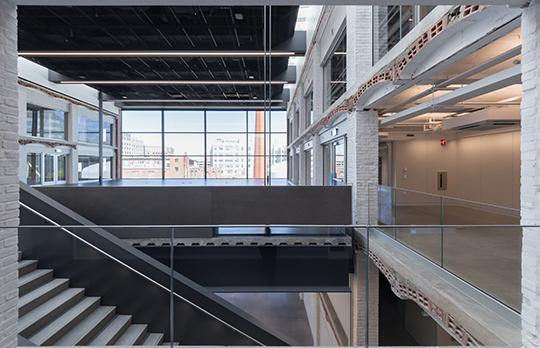
As the new home for SA+P, the MET is designed to foster collaborative, interdisciplinary work as well as interpersonal connection. Throughout the building, related spaces are organized into neighborhoods anchored by different aspects of design. Building-long walkways overlook studios and workshops, and a central stairway stretches from the main lobby to the top floor, creating a spine that connects the communities.
The team is targeting LEED Gold for this project.
Image credits
Details
Address
School or Unit
Use
Project Team
Architects: Diller Scofidio + Renfro (DS+R), lead designer, New York, NY; and Leers Weinzapfel Associates, associate architect, Boston, MA
Construction manager: Shawmut Design and Construction, Boston, MA
MIT Team: Nicole Bernabei, Brian Donnellan, Lachlan Patterson, Morgan Pinney
Scope
Design Features
- Adaptive reuse to transform an historic storage warehouse into academic and public space
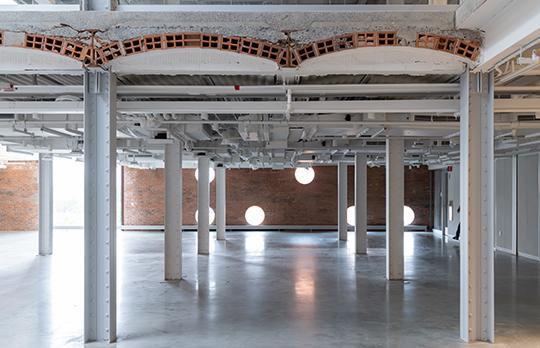
- Preservation of historical details including the brick exterior structure, corner tower, ironwork, painted lettering, crenellated cornices, and two-foot-thick masonry walls
- Continuous linear public stairway connecting interior communities
- Newly infused with daylight via the insertion of multistory, glass-walled studio stacks and new windows
- Column-free, high-ceilinged environments made possible through the use of lightweight modern floor slabs suspended within and supported by existing structure
- Classrooms and design studio space, increasing MIT’s capacity for design-oriented teaching and research
- Collaborative community spaces, fabrication shops, and research labs organized into “neighborhoods” throughout the building
- Flexible common areas and spaces designed to foster interdisciplinary collaboration, including studio-based courses developed with other schools and departments at MIT
- Exhibition and gallery spaces
- Auditorium
- Faculty offices
Sustainable Design Elements
- Adaptive reuse and repurposing of a critical historic building into a vibrant and sustainable student-focused facility, avoiding embodied carbon associated with demolition and new construction
- Low-emitting and Red List-free products used for interior finishes
- Increased natural light and views for users in most occupied spaces to support human wellbeing
- Landscaping features porous pavement and added trees, shrubs, and plantings to reduce the impermeability of the site and enhance pedestrian experience
- High-efficiency, electric heat pumps that lower energy use and reduce carbon emissions by utilizing excess heat from the district energy infrastructure and nearby facilities
- Mechanical equipment using non-toxic refrigerants installed to reduce embodied carbon
- Low-flow plumbing fixtures
- High-efficiency LED lighting and controls
- Critical equipement installed above the 2070 100-year design flood elevation (DFE) to support MIT's resiliency goals
- Targeting LEED Gold
News+Video
In the News
- Met Warehouse dedication ceremony launches new era; Once a storage castle, now a design stronghold, the landmark building is a major new hub at MIT. MIT News, October 2, 2026
- How architects turned a hulking brick box into MIT’s newest academic hub; A venerable storage facility has become a 21st-century architectural tour de force. Here are the key decisions that transformed the Met Warehouse. MIT News, September 4, 2026
- Met Warehouse opens as the new home of MIT’s School of Architecture and Planning; In a feat of adaptive reuse, a massive, century-old brick storage facility has been turned into a contemporary hub for collaboration and creative work; MIT News, August 12, 2026
- MIT Morningside Academy for Design created as a new hub for cross-disciplinary education, research, and innovation; Supported by a $100 million founding gift, the academy will deepen the integration of design across the Institute and beyond; MIT News, March 14, 2022
- Met Warehouse renovation planning takes an exciting next step; Community-driven selection of project architect opens opportunities to imagine new life for historic building as future home for School of Architecture and Planning; MIT News, December 14, 2018
- MIT Collaboration with Dar Group supports the future of architecture, planning, and design; MIT News, June 26, 2018
- Metropolitan Storage Warehouse is potential new location for School of Architecture and Planning; Historic building would create “design hub” for MIT, with benefits for surrounding community; MIT News, June 14, 2018