

Overview
Status
Completion Date
Themes and priorities
MIT’s conservatory-level music program is thriving; more than 1,500 students enroll in music courses each year, and the campus is home to a variety of ensembles and chamber groups. In recognition of this, the state-of-the-art Edward and Joyce Linde Music Building was constructed to support the popular program’s current and future needs.
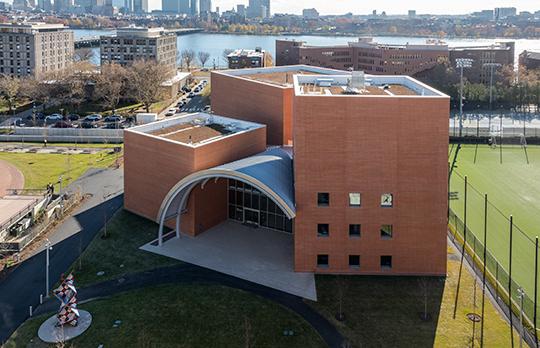
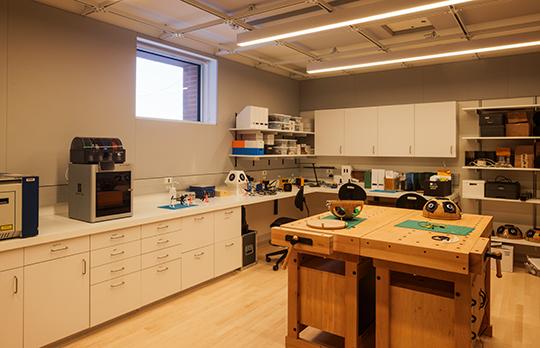
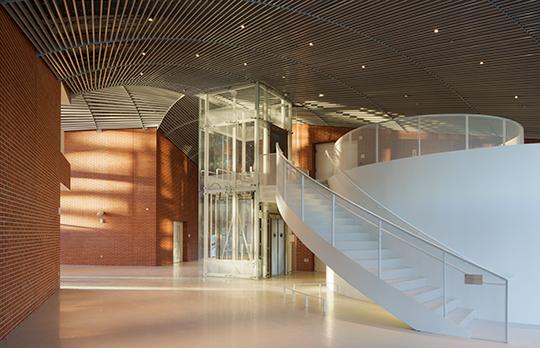
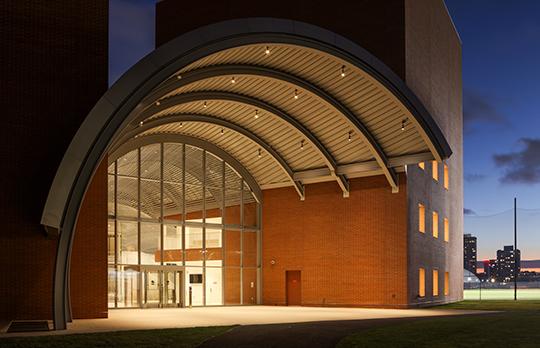
Designed by SANAA, the brick-clad building has three corresponding volumes – the Thomas Tull Concert Hall, the Jae S. and Kyuho Lim Music Maker Pavilion, and the Beatrice and Stephen Erdely Music and Culture Space – connected by a glass-walled lobby providing multiple entrance points that invite people to pass through the airy, open heart of the building. The volumes house rehearsal and recording spaces as well as a large-scale, purpose-built performance space, all incorporating sound-insulating walls and optimized acoustical design. Several indoor spaces serve as smaller, informal performance areas, and the outdoor plaza is configured to host performances. Below grade, a two-level garage provides approximately 140 parking spaces.
The building is sited within an illustrious context that includes Kresge Auditorium and the MIT Chapel (both designed by Eero Saarinen) and Baker House, designed by Alvar Aalto. In response, its design incorporates strong geometry, red brick, a stand of trees, and a curving curtainwall and roof that complement the iconic surrounding architecture. The outdoor pedestrian walkways align with the building's entrances, offering pathways through the building to connect the Johnson Athletic Center, the Zesiger Center, and the Stratton Student Center with nearby student residences. A grove of trees enhances the site, creating a campus green space that complements the historic Kresge quadrangle.
Designed to advance the vibrancy and diversity of MIT’s evolving West Campus sector, the Music Building was made possible by a cornerstone gift from Joyce Linde, a longtime supporter of MIT and the arts. The building has received LEED v4 Gold certification.
Image credits
Details
School or Unit
Use
Project Team
Design Architect: SANAA, Tokyo, Japan (2010 Pritzker prize profile)
Executive Architect: Perry Dean Rogers Partners Architects, Boston, MA
Acoustics Consultant: Nagata Acoustics, Los Angeles, CA
Landscape Architect: Reed Hilderbrand, Cambridge, MA
Construction manager: Lee Kennedy Construction, Quincy, MA
MIT Team: Joyand Charles, Vasso Mathes, Sarah Yazici
Scope
Design Features
- Three entrance points to eliminate any distinction between "front" and "back"
- Separate building volumes to ensure optimized acoustics, connected by a light-filled lobby space
- Design and landscape elements reflect and connect surrounding campus elements
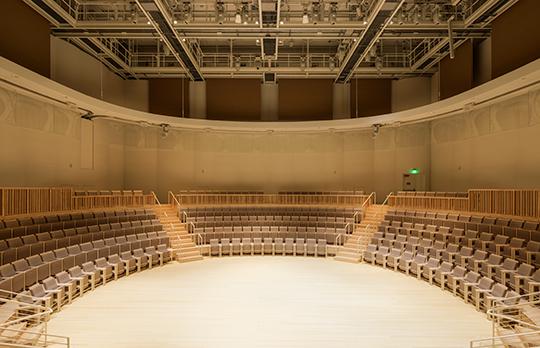
- Concert Hall with 360-degree seating to promote visual and acoustical intimacy
- Additional acoustical elementsof the Hall include tall ceiling height, heavy interior materials, variable curtains, suspended soffit, and resonant airspace beneath the cedar stage structure
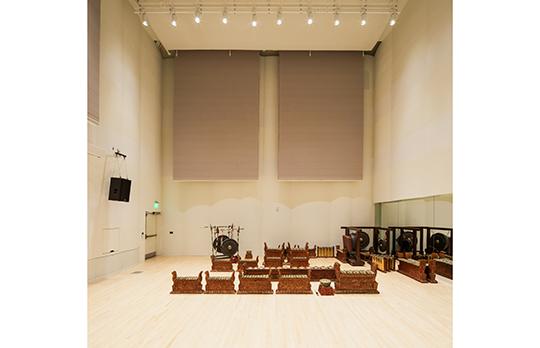
- High ceilings and large room air volume in Music + Culture Classroom to prevent acoustical saturation, paired with variable curtains and reduced reverberance to accommodate a range of instrumentation and ensemble sizes
- Professional-level recording capabilities
Sustainable Design Elements
- LEED v4 Gold certification
- High performance windows and envelope
- Highly insulated, high-mass, double-wall assembly for acoustic and energy performance
- Low-velocity air delivery
- Radiant floor heat
- Reflective roof material to reduce heat island effect
- Water use reduction
- Low-VOC, non-toxic materials and finishes
- FSC-certified wood
- LED sensor-driven lighting
- VAV system and right sizing of HVAC equipment to reduce energy use
- Entry canopy shading to prevent heat gain
- Green roofs on the volumes and landscaping above underground parking
- Green space, vegetation, and increased tree canopy to reduce urban heat island effect
- Integrated site stormwater management with landscape filters
News+Video
In the News
-
Seen and heard: The new Edward and Joyce Linde Music Building; MIT News, Dec 5, 2024
-
3 Questions: A new home for music at MIT; Keeril Makan describes how a new facility, now under construction, features rehearsal and performance spaces, a recording studio, classrooms, and music technology laboratories; MIT News, Jan 9, 2024
- Arts benefactor makes lead gift for new MIT music building; Commitment signals transformative moment for the Institute’s music programming; MIT News, Nov 25, 2018